How I Learned to Stop Telling Stories and Start Seeing Them

I thought my CEO was crazy. I couldn’t make sense of it.
“This is fantastic,” he said. He sat forward, spine straight as a stock chart. I saw dollar signs in his eyes. I’d just presented the core insight behind what’d become my first strategic narrative.
Not 3 years into my career, building marketing from the ground up, making it all up on the fly, and convinced that “Storytelling” was going to transform the world (of car dealership software), I was electric. The business world would know me. 30 under 30. English major and billionaire. Who’d’ve thought?
We’d make a new sales deck. We’d launch a new website. We’d create story-driven content, and then we’d be drowning in leads and pipeline and sales.
I’d be somebody.
But that didn’t happen.
We never used the sales deck. The website did generate leads. The content did get kudos and traffic and engagement.
But the company didn’t take off.
“English major mumbo-jumbo,” my CEO called storytelling. Not because it didn’t work.
“Clearly,” I said, stuffing the impact numbers onto my resume.
But because… well actually, I had no clue. Steve Jobs. Elon Musk. Marc Benioff. They’d used “Storytelling.” It’d been crucial to their success. So how could it be “mumbo-jumbo?”
The story I crafted clearly worked. The numbers proved it. Why was I the only one who used it?
I was confounded. I blamed the CEO. I asked for a raise. They said, “We think we’re getting what we’re paying for.”
And I left.
This is the beginning of something. Subscribe to follow where it goes.
The decade that followed was wild. I tried to be a travel influencer. I crashed my motorbike. I joined a startup. I burnt out. I walked through a portal in Japan. I started my consultancy. I evacuated Medellin during COVID. I shipped strategic narratives. I joined another startup. I got laid off. I moved to South America. I saw some crazy shit. I shipped some crazy narratives. I learned a ton. And I completely changed how I see reality.
The whole time I had a chip on my shoulder. I had to prove that “Storytelling” mattered. That storytellers belong in business.
I’ve had success. I’ve had clients call me a genius. I’ve had them say that my work changed their lives and companies.
And through all of that, I’ve gained perspective, which permits me to reflect; to be honest. To finally look truth in the face and admit that which I’ve feared to admit, which is that…
Business is no place for “Storytellers.”
Seriously. I’ve been at this for a decade, and I now believe that “Storytelling” can lead us nowhere but disaster.
I was the embodiment of “Storytelling.” I lived this predominant paradigm with all its assumptions. I made it my identity. I invoked the Silicon Valley greats alongside Martin Luther King and Mahatma Gandhi and Leo Tolstoy. I fell deeply into the complexity and contradictions and finally came to the conclusion that I was a fucking diva. A prima donna. One who betrayed the story.
That first strategic narrative? I got it all wrong. Not the content per se, but the intent.
It was never about the company, never about my team, never about the customer, and certainly never about their evolution.
It was about me.
I was the hero. I was the genius. I was going to save the business.
I made the market, the customers, the team, the CEO, and everyone else into props for my story. I objectified them. I treated them as “Its.”
And that’s the heart of the “Storytelling” paradigm.
And now we’re trapped in a “Storytelling” war.
It’s an escalating narrative arms race where the only way anyone can think to cut through the bullshit is to bullshit better.
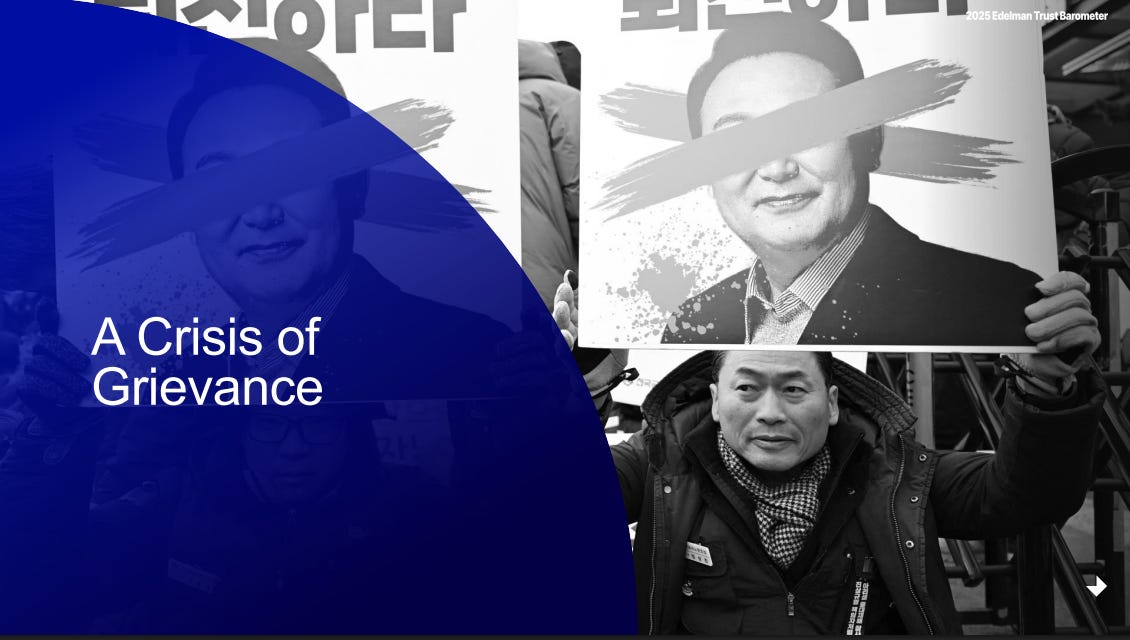
The Edelman Trust Barometer shows us that things are bad. That we’re in a crisis of grievance. That trust has collapsed. People don’t trust journalists. They don’t trust CEOs. They don’t trust politicians, or companies, or each other.
And amidst this crisis of trust, businesses are now scrambling to hire “Storytelling” talent.
“Some companies want a media relations manager by a slightly flashier name,” says the Wall Street Journal. “Others need people to produce blogs, podcasts, case studies and more types of branded content to attract customers, investors and potential recruits.”
The paradigm is alive in this article. “Storytelling” as communication. “Storytelling” as marketing. “Storytelling” as a persuasive technique for cutting through the bullshit by seeming “authentic” and “human” and “relatable.”
But remember—it’s not about the content. It’s about the intent.
If we treat customers as objects and do not genuinely care about their evolution, then our stories are bullshit. We will find ourselves caught in an arms race that we cannot win. Every “Storytelling” advantage we gain will be fleeting. Our opponents will copy it. Our audience will get more fatigued. And our only solution will be to hire better “Storytellers” to craft more persuasive stories that’ll only deepen the cycle until no one knows what’s real anymore.
Aren’t we there already?
Before I go any further, let me clarify something about “Storytelling.”
There are hundreds of thousands (if not millions) of us who identify as “Storytellers.” Who believe in “Storytelling.” Who might react to what I’ve written by saying, “that’s not me!”
I want to honor you. You believe in the power of story. And so do I. It can change your business, and it can change the world. Look at those storytelling luminaries I mentioned before and you can see quite clearly there’s something amazing there.
My problem is not with story itself or any of those who practice it. It’s with the way we think about it. The foundational assumptions about what it is and what it’s for.
The “Storytelling” paradigm assumes that stories are things we make up. They are subjective human constructs with no inherent correspondence to reality. They take the form of artifacts like sales decks, taglines, or content, or as cognitive frameworks designed for communication. Stories are made up by humans. That’s what most of us assume.
And that assumption is killing us.
Most business strategy fails.
Startups received $425 billion in funding in 2025, and 90% of them will fail.
IDC predicts we’ll spend $4 trillion on corporate transformations by 2027, and McKinsey says 70% of those fail.
Enterprises spent $30-40 billion on AI pilots over the last 3 years, but 95% of those failed to impact the P&L.
Those failure rates are insane. And so is the price tag. $267 billion annually—a fraction of what we burn—would solve world hunger. The world would be a much nicer place if we (collectively) didn’t suck at strategy.
So what do we have to blame for those failure rates? You guessed it.
“Storytelling.”
Remember that assumption that stories are made up? It’s loaded. Because if stories are just bullshit that we make up, then so is meaning.
Because meaning is fundamental to story. And story is the only vehicle through which meaning becomes livable. Which means if stories are just bullshit we make up, then so is meaning. And if meaning is just bullshit we make up, then so is purpose. And if purpose is just bullshit we make up, then so is strategy. And if strategy is just bullshit we make up, then we get cascading coordination failures across every level of society and business.
It’s simple.
Coordination requires meaning. It requires everyone being on the same page. And if everyone gets to just make up their own story about what’s happening and what it means; if there is no metaphysical basis for orienting around shared reality, then you get what we’ve been documenting. Failure. At scale. Across everything.
If stories cannot exist in reality beyond our imaginations, then you can only get “Storytelling”—a civilization of people bullshitting each other, empowered by exponential technology and evermore persuasive “Storytelling” techniques.
Which is why we must learn to see stories.
And that’s not enough. We must learn to be StorySeers.
There was a moment earlier this year when my identity shifted. I forgot my girlfriend’s birthday. I’d been so consumed with building StorySeer and my own personal growth that somehow it slipped.
I love her. And to love is a choice. I can’t do it if I’m self-absorbed. And so I resolved to find help.
I was deep into the Figma case study at the time, act 4. I needed a theory to understand how they related to customers. What made it so special? How did they make customers feel safe enough to transform? What even is a relationship?
A book appeared. The answer to all my questions. It’s called I and Thou by philosopher Martin Buber. And it changed me.
Buber says that you can relate to anything or anyone in life in one of two ways: you can treat them as an “It,” which is an object or an instrument by which you get what you want; or you can treat them as a “Thou,” which is another being with whom you enter into genuine, loving dialogue.
Are you an object of my desire? Do I want something from you? Is the story I’m telling you designed to help me get it? Then I’ve made you an “It.”
Are you another being? Am I meeting you with openness and vulnerability? Does the story I share come from a place of understanding that my evolution is inextricably bound to yours? Then you’re my “Thou.”
The floor dropped. I saw myself. I’d so often been stuck treating everything and everyone as an “It”—my girlfriend, my business, all the stakeholders in my first strategic narrative, and even myself. Especially myself.
And I saw that Figma, led by their CEO Dylan Field, met their customers as “Thou’s.” They entered into a dialogic, co-creative relationship with them; and deepening that relationship became their North Star—their center of shared meaning—that guided everything they did, from product to engineering to go-to-market and beyond.
When our customers are in crisis; when the old way of being is no longer working, and they must evolve in order to adapt to a new world, we must treat them as “Thou’s.” That means the story we share cannot be designed to persuade.
The story we share must reveal the truth.
Story is not for persuasion. It’s for revelation.
Story is not for communication. Communication is for story.
I wrote last time that stories are observable patterns in reality. That there is a story happening right now in our markets, and our customers are living it. Their worlds are shifting. Their status quo has broken. They know that something is wrong, and that something needs to change, but they can’t put their fingers on what. As StorySeers, our job is to show them; to name what they’re already experiencing, and then to illuminate their path towards transformation. We are here to serve their becoming.
MLK didn’t invent the story he shared. He didn’t invent the civil rights crisis. He saw it. He saw the evolution already trying to emerge, and when he shared it, Americans recognized it as truth.
Dylan Field didn’t invent the UX/UI design crisis. He saw it. He saw that designers were stuck working as solitary creative geniuses, and helped them evolve into strategic collaborators.
When we see clearly where our markets are going, and how our customers must evolve; if we communicate this story faithfully, they will immediately, deep within their bones, recognize it as truth.
I'm building this in public. Subscribe to follow the work.
But in order to see these stories, we must change the way we see.
Which is not easy. It’s taken me a decade. I can’t tell you how frustrating it’s been to know that there was something transformative about story, but to have neither language nor concept to explain it.
I’ve studied. I’ve practiced. I’ve had clients fervently recommend my work only to be told, “We don’t need storytelling” despite needing help with the very problems I solve.
It’s a paradigm problem. When we’re selling something new; when it goes against established thinking and assumptions, we need to be crystal clear on exactly what those assumptions are, why they no longer serve, and how our customers can evolve. We need to get the story straight.
What follows is the story of how I got my story straight.
I needed to completely change the way I saw stories.
I’ve already intimated how. Not persuasion, but revelation. Not communication, but that which is communicated. But what does that even mean? And what even is a story, anyway?
I was first inspired to pursue strategic narrative by a consultant named Andy Raskin. A core part of his philosophy is captured by a quote from venture capitalist Ben Horowitz which says that, “the company story is the company strategy.”
I drank it up. I was 25 and intent on affirming my existence. Story equals strategy—the most important thing in business.
But if I’m being honest, I had no clue what that meant, or how it could be the case. Wasn’t a story like a book? A movie? An anecdote of your weekend misadventures? Maybe, at best, a powerpoint deck? A tagline?
I, like most people who hear the word “story,” thought about artifacts. The physical manifestations. The communications.
Which made sense at the time. I was a marketer. Communication artifacts were my jam. My job was to take the strategy and product my CEO gave me and do some “English major mumbo-jumbo” to make them pop. I was to wrap them in a shiny layer of story that’d engage our buyers’ mirror neurons and flood their brains with oxytocin, which would make them fall in love with our brand and shower us with money.
But that, of course, didn’t work. It’s the “Storytelling” workflow. Serious, objective business strategy happens over there. Subjective story bullshit happens over here with marketing. They are categorically separate things.
But when the strategy and its product arrived at my station on the assembly line, they were missing some critical narrative (strategic) elements.
Who was the protagonist of our story, really? Car dealers? There’s over 18,000 rooftops in the U.S. alone. Ford? Mazda? Donkervoort? Corporate dealers with national footprints, or family-owned independents with one or two rooftops? We talking to the owner? The GM? The sales manager?
Next, why would any of them care? How did we define the status quo, and what had changed such that it no longer worked? The most common reason deals are lost is because prospects choose to do nothing. Maintain the status quo. If they don’t see a good reason to change what they’re doing right now with urgency, they’re never going to do it.
And lastly, how exactly did they need to change? What was the new winning strategy that’d help them thrive in their new environment?
None of these are trivial questions. They are foundational. Every aspect of a company’s strategy and execution emerges from the answers.
And so what I should’ve done was orchestrate a collaborative strategic process among the leadership team, led by the CEO, to synthesize the multitude of perspectives required to align everyone behind a clear strategy that made sense. Instead, I did some market research and inferred the answers myself. No one else was included. Not a single one of us knew that anyone but me even should be.
That’s no one’s fault. It was our assumption. Story is for communication. Communication is handled by marketing, which creates the story artifacts that engage buyers. “Storytelling.”
In the decade that followed, I ran into versions of that same problem over and over and over again. None of us knew what story really was. And so we didn’t really know what to do with it. We made some awesome decks. We got some awesome results. We didn’t change the world. I was frustrated.
But then, about a year ago, something clicked.
I’d been excavating my interiority for 5 years. Learning about the bullshit “Storytelling” I was doing in my own life and how to stop. I was reorienting my life and values, and emerging from two years of pro-bono social impact work, when I had an insight.
Stories and strategies are the same things. Literally.
I gave a presentation at a B2B marketing community, Dave Gerhardt’s Exit Five. It was on strategic narrative. And that insight made the whole thing pop.
Think about it. To form a strategy, we must answer five simple questions:
- What is happening?
- What does it mean?
- What should we do?
- How do we do it?
- What’s our desired result?
It turns out that these five questions map perfectly onto a universal five act story structure:
- Something happens…
- …which sets in motion a crisis…
- …which forces the protagonist to evolve…
- …which requires them to overcome obstacles…
- …to be transformed.
They are literally the same thing. Story (AKA strategy) is how our brains orient our behavior towards desired outcomes.
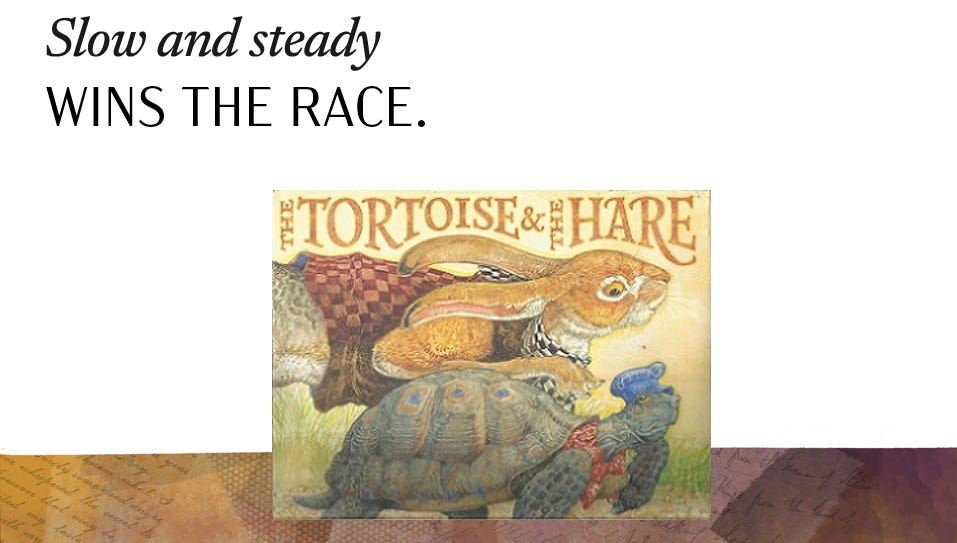
Slow and steady wins the race. That’s a strategy.
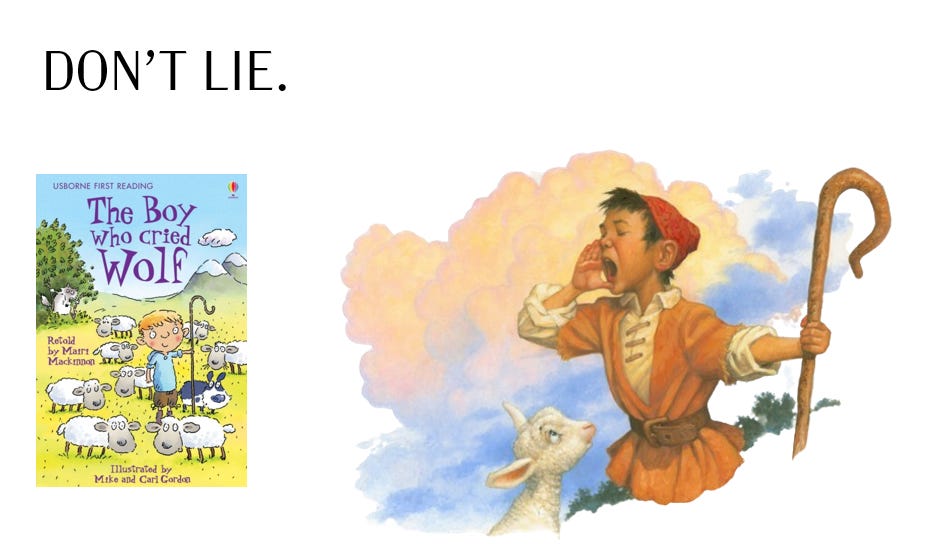
Don’t lie, or no one will take you seriously when you cry wolf. That’s a strategy.
So stories (strategies) aren’t artifacts. They’re cognitive frameworks. Ben Horowitz’s quote suddenly made sense.
And the reaction from marketers was promising. A number of them worked with me afterwards with successful results.
But something still wasn’t right.
My insight showed that at very least, strategies look like stories. They have the same structure. But so what?
I created stories for clients. I created stories for myself. Excellent stories with excellent craft. But none of us became the next Figma. None of us became the next MLK. Narrative structure clearly wasn’t enough.
The difference between Figma’s strategic narrative and my own StorySeer narrative, for instance, isn’t structure. It’s content.
It’s blindingly obvious. We can have a perfectly structured story and still not change the world. Structure is not enough. We need content. And not just any content, but truth. Reality.
The story our customers are actually living.
We all went to school. We all sat in uniform rows, followed instructions, and crammed information into our heads. Perform well. Get good grades. Go to good universities. Get good jobs.
That Industrial Age model of education is predicated on the answer to one deep question: “What are humans for?”
That question was the opening line of my client’s nationally-televised keynote: How Curiosity Can Save the Future.
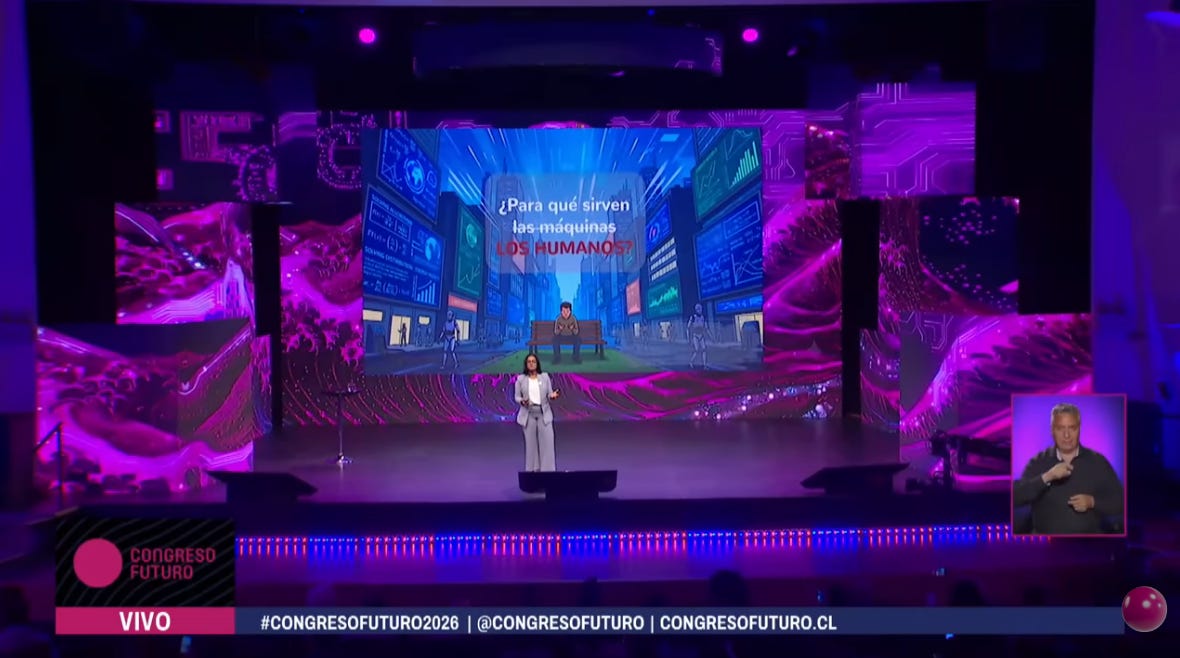
Humans are for progress. We measured progress with productivity. Somewhere along the way, measurement became meaning. Humans are for productivity.
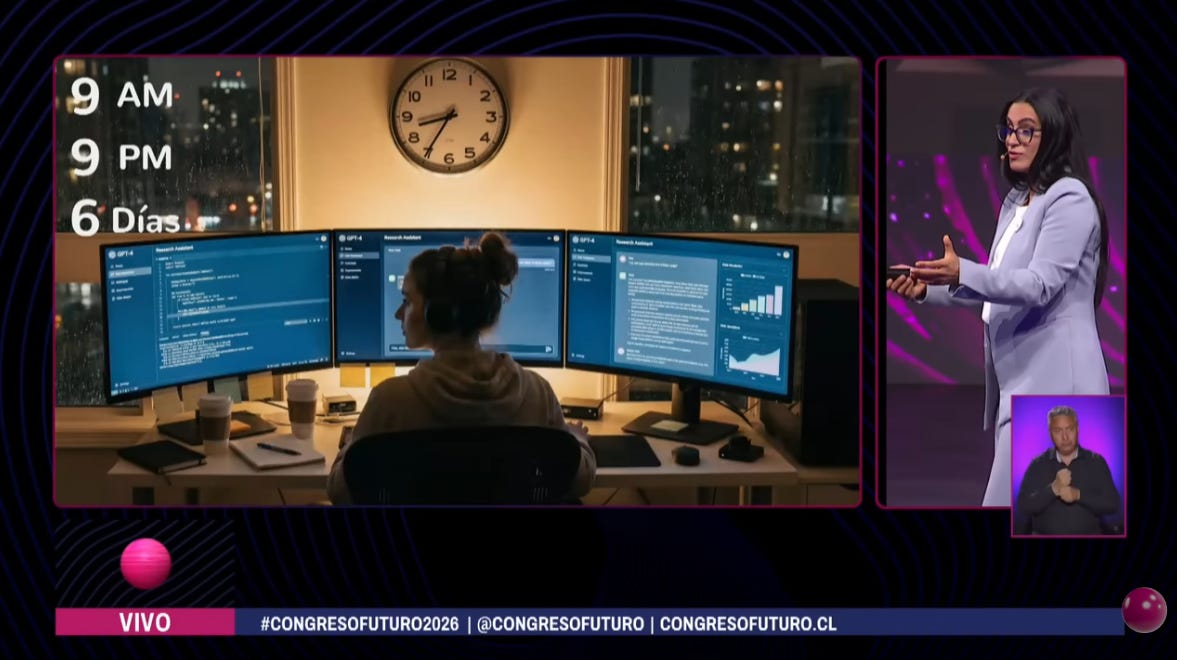
But what happens when machines become more productive than humans at virtually everything we do for work? To what extent does this call into question the foundational assumption of our education system? Is preparing students for the job market really the best reason we can give them for learning? Or is there something deeper?
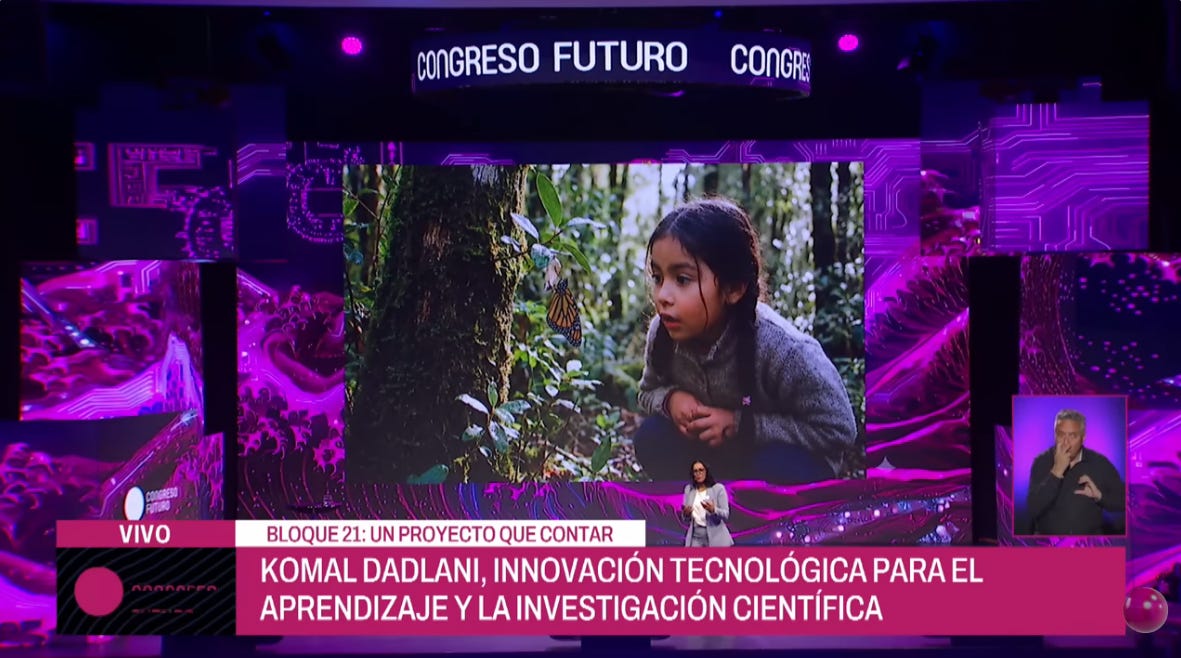
She paused before telling us, “Go back to your childhood to the first time something in the world absolutely amazed you; filled you with wonder; made you curious. Why is the sky blue? Why do volcanoes erupt? Does the caterpillar really become the butterfly? How?”
“Now ask yourself, as an adult, ‘Why did it make you curious? Why did it fill you with wonder? Why is it beautiful?’”
She paused before answering, “Because it just is. It just is beautiful, intrinsically. And as children, we just know it, intrinsically. We’re born knowing that the world is valuable and worth our attention, just because it is.”
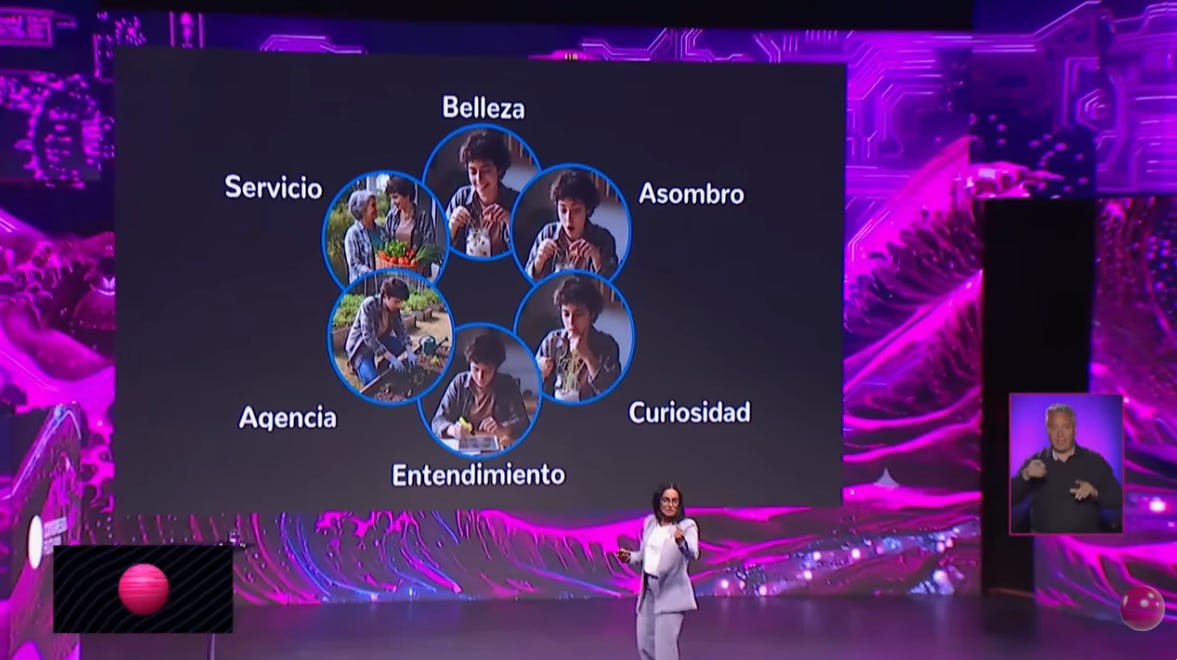
She went on to map what she calls the virtuous cycle. “Beauty. Wonder. Curiosity. Understanding. Agency. Service. Could this be what humans are for?”
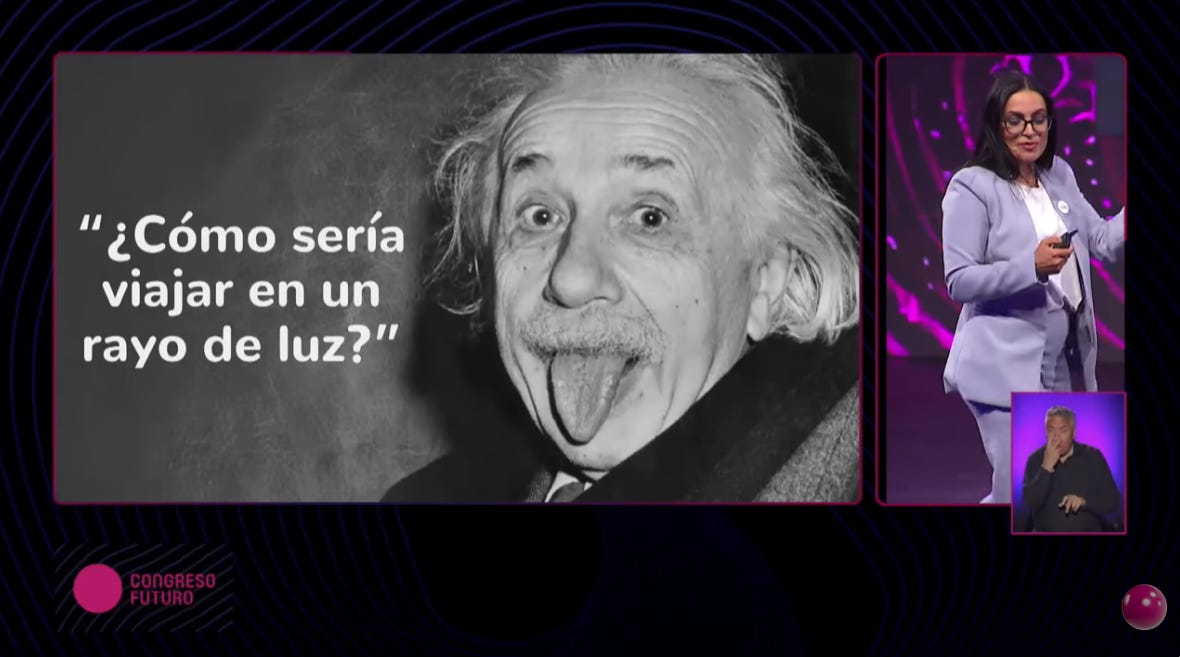
“Einstein said he had no special talents. Only passionate curiosity. He discovered relativity by asking a childlike question: ‘What would it be like to ride on a beam of light?’”
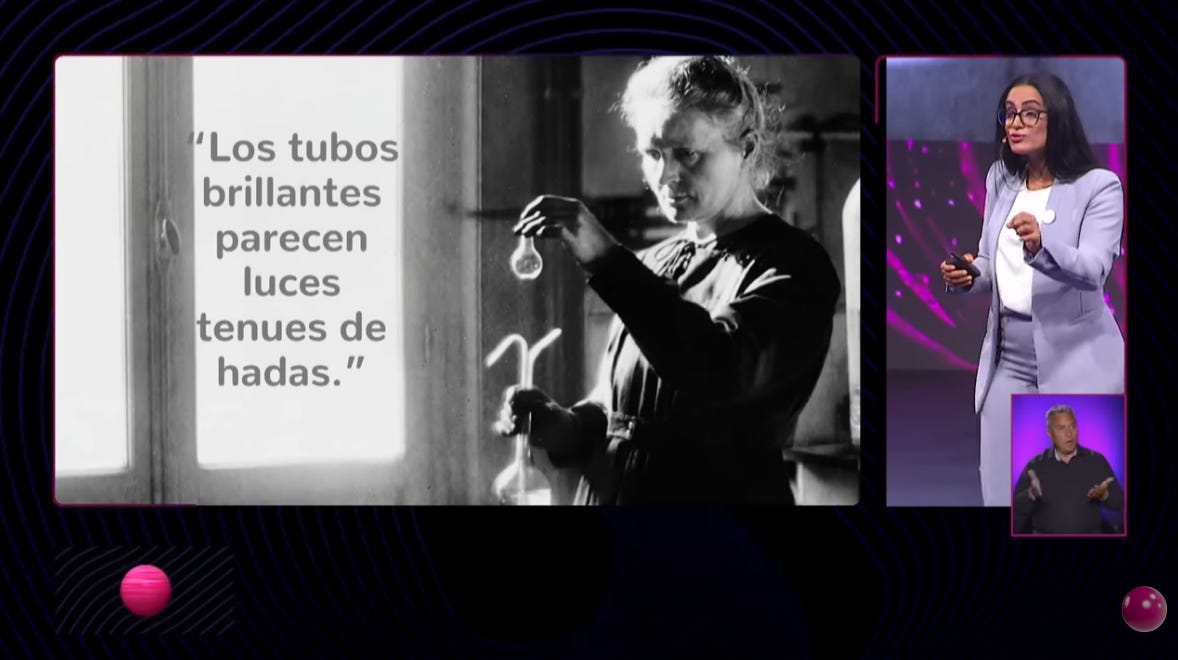
“Marie Curie processed eight tons of pitchblende by hand because she had to understand why it glowed in the dark. She kept radium samples by her bedside at night. She said they looked like faint fairy lights.”
“These weren’t just intelligent people. They were people who never stopped being curious. Who never lost their wonder. Who stayed in that virtuous cycle. And every single one of us is born with that capacity.”
This section of her keynote (act 3) ended on a question: “...what would the education system look like if we nurtured that capacity?” Or, paraphrasing, how might we redesign education for curiosity, not productivity?
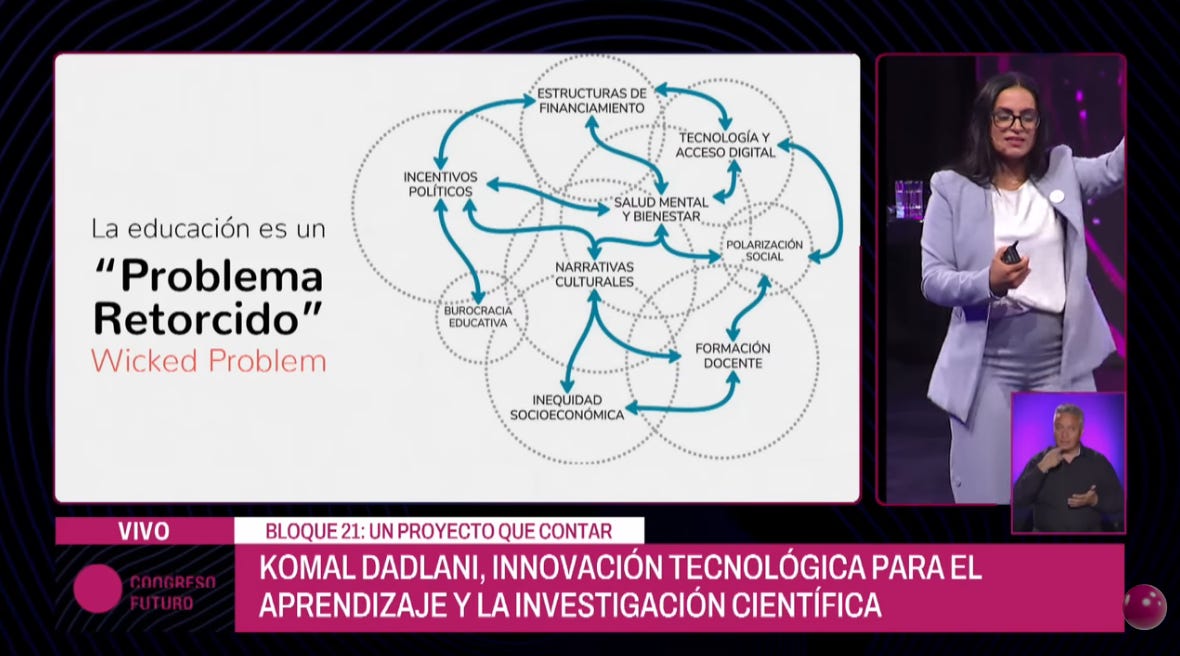
She went on to reveal the wicked problem of educational reform. She invoked her decade-long experience building Lab4U—an experiential STEM learning startup.
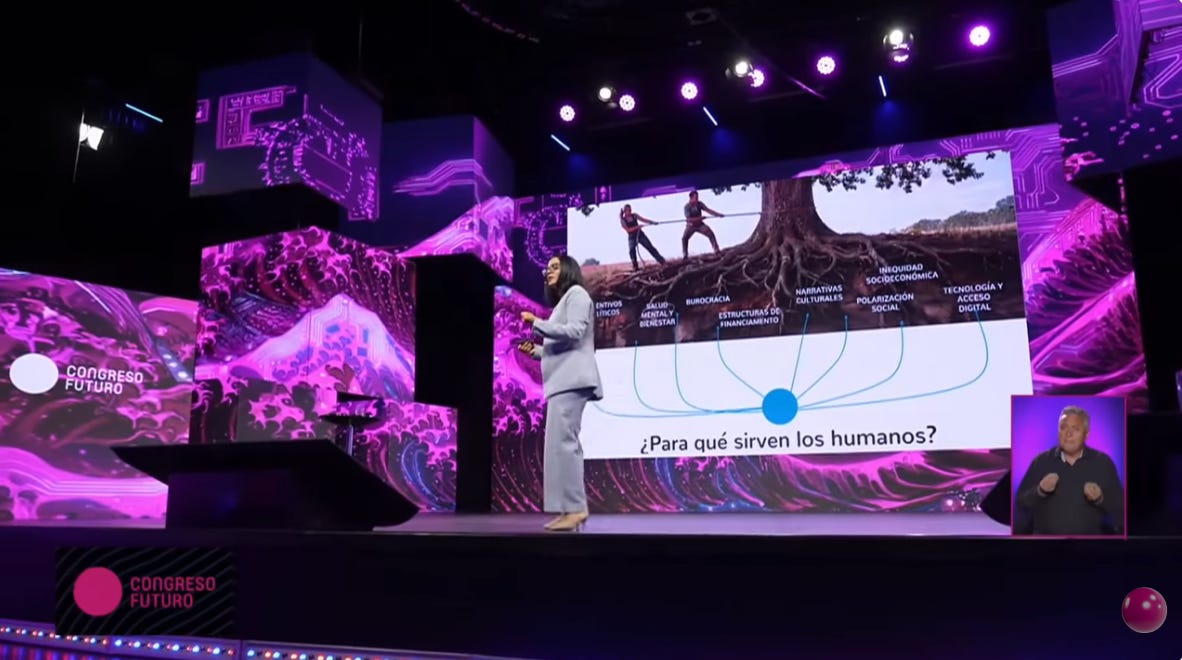
She identified the answer to that foundational question, “What are humans for?” as the leverage point for igniting systemic transformation, and then reminds every member of the audience that they are part of the answer.
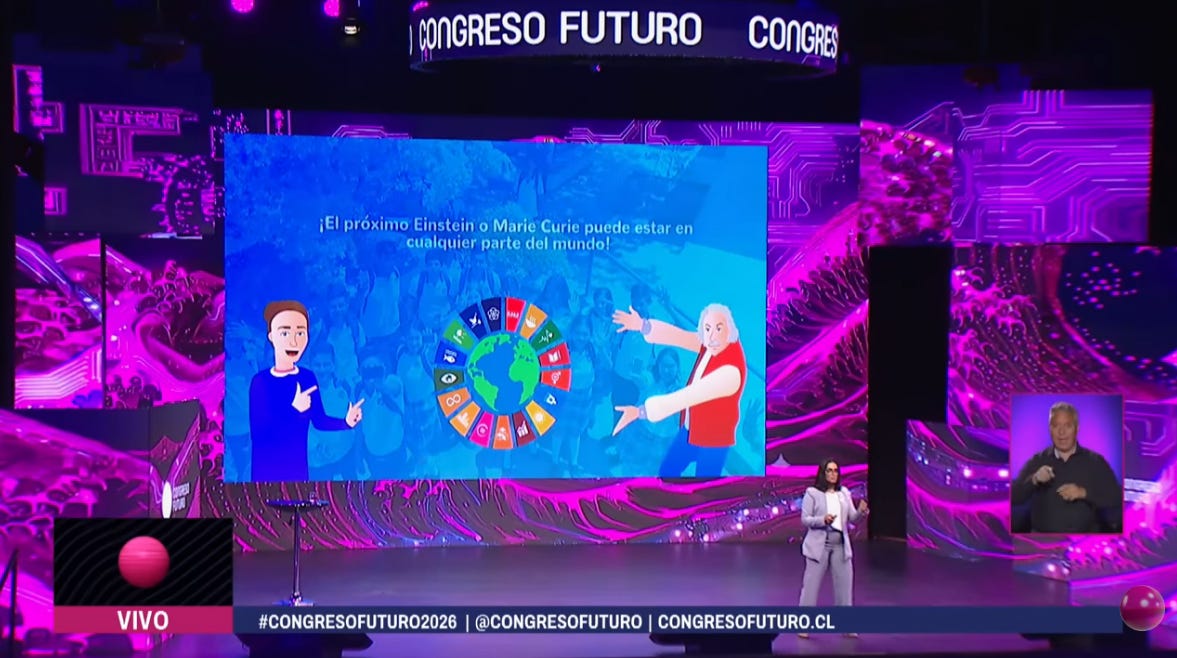
She named the reality her audience was already living.
She showed the status quo in crisis, proposed a new paradigm for education, elucidated the wicked problem standing in the way, and then started the long, complex process of creating the conditions by which the system can be transformed. That is a strategy. That is a story.
That is not “Storytelling.”
She didn’t make the story up. She saw it; the one that’s actually happening in reality. And now, it’s all about creating the conditions by which the story she sees—the evolution that wants to happen—can come to fruition.
Stories are patterns in reality. They are the patterns by which customers, markets, and perhaps reality itself evolve. Our job is to see these stories in progress, see where they want to go, and then create the conditions to help them get there.
Narrative craft is strategic craft.
And StorySeers do not use story to influence behavior. They use it to see. They apply narrative craft to solve strategic problems. Clear communication is a byproduct of clear strategic seeing. It’s downstream of strategy which is downstream of story.
What people experience as narrative transport (the felt experience of being absorbed by a story) is actually I-Thou contact with reality. It’s also the same thing as Komal’s virtuous cycle. The StorySeer’s job is to create the conditions by which their customers, investors, employees, and other stakeholders are consistently brought there by every touchpoint with their company. Stakeholders don’t lose themselves in the story. They find themselves.
StorySeers are evolutionaries.
Customers, markets, and complex adaptive systems evolve. Those evolutions follow narrative structure. Technological disruptions and market evolutions follow narrative structure. Systemic transformation follows narrative structure. The StorySeer’s job is to make visible these evolutions so that everyone can serve them, and in doing so, serve themselves.
Because serving evolution is what gives us meaning. And meaning isn’t something we invent. It’s something we align with. And the moment we stop making reality into a prop for our own story—the moment we actually see it—is the moment we find something worth serving.
That requires that we get out of our own way.
My CEO wasn’t the crazy one. I was. Or maybe we all were. Maybe we’ve all had our vision obscured by our bullshit “Storytelling.”
Or maybe it’s just me. I can’t “Storytell.” I can’t assume that everyone’s experience is like mine.
But what I can tell you is what I believe. I believe that all of us are living the same story; that all of us are part of the same evolution. From the big bang to hydrogen gas to stars and stardust to planets and microbes and plants and animals and humans, I believe that the universe has a destiny, and that all of our destinies are to help it get there.
What I’m learning is this: that for any strategy I employ in my life, the biggest obstacle is me. I cannot see the story anyone else is living if I’m too busy trying to write them into my own.
More coming. Subscribe.